June 25, 2026
More details ↓
Common Eastern Fireflies synchronize their breeding displays at peak summer, when nights are shortest but their bioluminescent signals most visible to mates in the landscape's understory.
The light is still fading at nine o'clock. In the understory along Bethesda's wooded edges, where flowering dogwood and pawpaw hold the middle layer and the canopy closes overhead, the first flashes appear low to the ground, maybe a foot or two above the grass. They are yellow-green, brief, and arcing slightly upward. By the time full dark settles in, there are dozens of them.
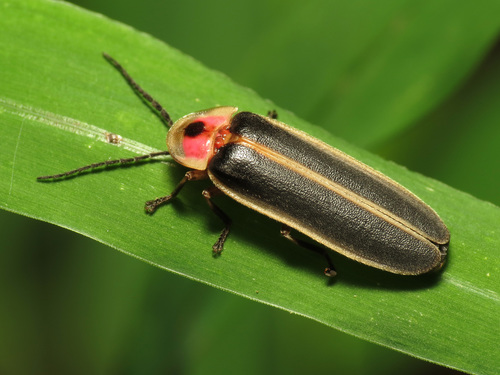
These are common eastern fireflies, and what you are watching is a conversation. The males fly and flash; the females wait, perched on vegetation, watching. The male's signal follows a precise pattern: a single flash lasting about half a second, then a pause of roughly six seconds, then another flash. The arc of the flight is part of it too. Females who are ready to mate flash back after a fixed delay, typically about two seconds. That timing is the key. Males scanning the dark learn to read it. A female who answers at the right interval draws the male toward her, and he flashes again, and she answers again, and he homes in. The whole exchange can take several minutes before the male lands.
This is peak season for them. The nights are the shortest they will be all year, which means the window for signaling is compressed. But the warmth matters as much as the darkness. Common eastern fireflies are most active when air temperatures stay above roughly 21 degrees Celsius after sunset, and summer nights here hold that heat. The flashing typically begins in the first hour after dark and tapers off by midnight. On a warm, still night with low wind, the signals carry well and the activity is dense. On cooler nights, or nights with rain, it falls away quickly.
The light itself is produced in the abdomen, in a specialized organ that runs a chemical reaction involving a compound called luciferin, an enzyme called luciferase, and oxygen. The reaction produces light with almost no heat, which is unusual for a light-producing process. The firefly controls the flash by controlling the oxygen supply to the organ. The precision of the timing, the duration, the interval, is all physiological, controlled by the nervous system. Different firefly species in the same habitat use different flash patterns and different colors, which is how a female tells her own species from others flying nearby. In the same meadow edge, you might have several species active at once, each running a different signal.
The larvae spend most of their lives underground or in leaf litter, where they are predators of soft-bodied invertebrates including earthworms and snails. The adult firefly, the one flashing now, does not eat at all, or eats very little. The adult stage is entirely about reproduction. The females of some firefly species mimic the flash responses of other species to lure males and eat them, but common eastern fireflies do not do this. The adults live only a few weeks.
Spotted lanternfly, an invasive species now established in this area, feeds heavily on a wide range of woody plants in summer, and its presence has altered some of the understory structure that fireflies depend on. Invasive Amur honeysuckle thickens the shrub layer in ways that can reduce the open, grassy edges where males fly and females perch to watch. These are slow pressures, not sudden ones, but they shape what the habitat looks like over time.
If you are outside now, or near a window facing a wooded edge, look low. The males rarely fly more than a few meters off the ground during the early display. The flash lasts less than a second, then the beetle coasts dark for six seconds before flashing again. If you count the interval, you can tell whether what you are seeing is a male searching or a female answering. The females tend to flash from a fixed point; the males move. Watch one long enough and you can see the arc of the flight between flashes, a faint shape moving through the dark.
